

Springtails in Alabama homes are a moisture problem before they’re a pest problem. These tiny jumping insects don’t bite, don’t spread disease, and don’t damage your home or belongings. What they signal is that somewhere in or around your structure, humidity or organic material has built up to levels that support their population. UC IPM is direct on this: pesticides won’t provide long-term control by themselves. Moisture reduction is the primary solution. Alabama’s year-round humidity makes moisture reduction harder to sustain than in drier climates, which is why springtail problems here tend to be more persistent.
Key Takeaways
- Springtails are harmless. They don’t bite, sting, or damage household materials. Their presence signals excess moisture or organic buildup, not an infestation in the traditional sense.
- Moisture control is the only lasting solution. Drying out the affected area eliminates the conditions springtails need to survive. Sprays kill visible individuals but don’t address the source.
- Alabama’s year-round humidity makes springtail pressure persistent, particularly in homes with crawl spaces, overwatered landscaping, or drainage problems near the foundation.
How To Get Rid Of Springtails: What Actually Works
Springtail control starts with drying out the problem area, not with spraying. Without moisture reduction, even effective treatments produce only temporary relief as new individuals migrate in from outside.
Identify and Fix Moisture Sources First
Before treating, locate where moisture is accumulating. Check under sinks, around toilet bases, behind washing machines, near dishwasher lines, and around HVAC condensate pans. Any slow drip or pooling condensation that goes unaddressed creates the sustained damp conditions springtails need.
Outside, check that downspouts direct water well away from the foundation. Irrigation systems that run close to the structure, low-lying areas that collect standing water after rain, and dense mulch beds pressed against foundation walls all keep soil wet against the home longer than it should be. University of Minnesota Extension notes that rain spouts that don’t carry water far enough from the foundation, landscapes that slope toward buildings, and excessive irrigation are among the most consistent contributors to springtail pressure near structures.
Dry Out Affected Indoor Areas
Once moisture sources are identified, dry the area actively. Run a dehumidifier in basements and crawl spaces. Use a fan to accelerate drying in bathrooms, laundry rooms, and other enclosed spaces with persistent humidity. Airing out and drying infested areas is an effective indoor control method on its own, per UC IPM. Target indoor humidity below 60 percent in problem areas; springtails require high moisture to survive and reproduce.
For springtails in houseplant soil, let the soil dry completely between waterings. Springtails thrive in peat-heavy, consistently damp potting mixes. Removing standing water from plant saucers eliminates a common indoor breeding site that’s easy to overlook.
Vacuum Visible Springtails
Vacuuming is the most immediately effective mechanical control for springtails already indoors. Vacuum around sinks, bathtubs, floor drains, and basement walls where they congregate. Empty the canister or remove the bag outside immediately after each session. UC IPM specifically recommends washing springtails found in sinks and bathtubs directly down the drain. Never spray or pour insecticide down drain lines.
Reduce Outdoor Harborage Near the Foundation
Mulch deeper than two to three inches stays wet long enough to support large springtail populations right against the structure. Pull mulch back from the foundation to create a dry barrier. Remove leaf litter, decaying organic debris, and woodpiles from the foundation perimeter. Trim shrubs and ornamental vegetation back at least two feet from exterior walls to reduce the moisture and shade that accumulate close to the structure.
Seal Entry Points
Springtails enter through door thresholds, weep holes in brick veneer, utility penetrations, crawl space vents, and window screens. Caulk gaps around utility lines and window frames. Check that crawl space vents have intact screening. Weatherstrip exterior doors, particularly at the threshold where springtails trail inside from soil-level populations.
When Spraying Makes Sense
Pesticides alone don’t provide lasting springtail control. If perimeter treatment is used as a supplement to moisture and habitat management, residual insecticide applied in a band around the exterior during active migration can reduce how many reach the structure. This works best when applied to the soil and mulch in the problem zone rather than to surfaces the springtails are already on.
Why Springtail Problems Persist in Alabama Homes
Alabama’s climate creates the conditions springtails need to thrive year-round, and the state’s housing patterns add specific vulnerabilities that make indoor pressure higher than in drier states.
The Climate Factor
Springtails require high ambient humidity to survive. Most species die quickly in dry conditions, which is why they’re far more common in the Southeast than in arid regions. Alabama’s humid subtropical climate, with its warm temperatures, high annual rainfall, and minimal dry seasons, gives outdoor springtail populations a near-constant favorable environment. There is no extended period where outdoor conditions alone eliminate them.
After heavy rain, saturated soil pushes springtail populations toward structures in large numbers. During dry spells, they move toward structures in search of moisture. Either weather pattern can produce a sudden influx indoors, which is why Alabama homeowners often see springtails appear without any change in household habits.
The Crawl Space Problem
Many Alabama homes, particularly older construction in Birmingham, Huntsville, and Madison built before slab-on-grade became standard, have crawl spaces that hold ground moisture year-round. A crawl space without a vapor barrier, or with a failing one, maintains humidity levels that support continuous springtail populations directly beneath the living area. These populations migrate upward through subfloor penetrations, particularly in fall and spring when outdoor temperatures shift.
New Construction and Landscaping
New sod installed around recently built homes has to be kept consistently moist during establishment, which creates a temporary but significant springtail habitat right at the foundation. Fresh mulch beds, a standard part of new home landscaping across Alabama’s growing suburbs in Madison, Huntsville, and Jefferson County, are often contaminated with springtails and can introduce or re-introduce populations to the property with each seasonal reapplication.
What Springtails Are and How to Identify Them
Springtails (order Collembola) are technically hexapods rather than insects, though the distinction matters little for control purposes. The feature most homeowners notice first is the jump. Springtails get their name from a forked appendage called the furcula tucked under the abdomen. When threatened, the furcula releases and propels them several inches into the air.
Identifying Springtails
Springtails are very small, between one-sixteenth and one-eighth of an inch long, with slender, elongated bodies. Color varies by species but most are dark brown, gray, or black. Some species are white or translucent, making them harder to spot on light-colored surfaces. They have moderate-length antennae and no wings.
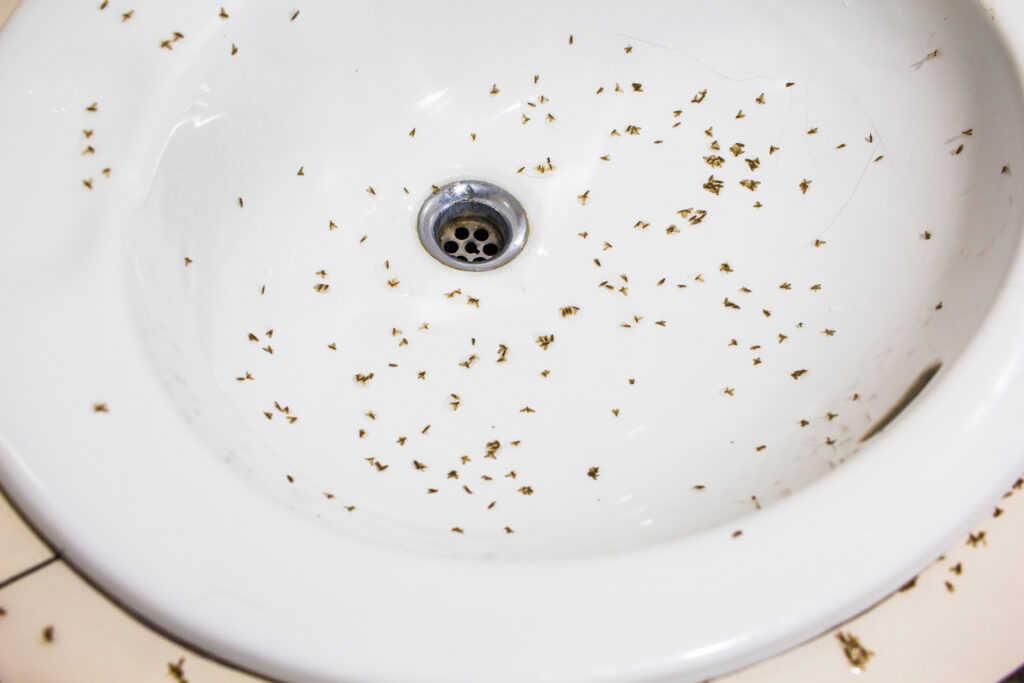
The most common indoor sighting is a cluster of tiny dark specks near a drain, sink, or bathtub that scatter and jump when disturbed. Finding them in plant soil is also common, where they appear as small dark particles moving through the top layer of damp potting mix.
How to Tell Springtails from Fleas
The most common misidentification is with fleas, particularly because both are small and jump. The differences are meaningful for treatment.
Springtails are found near moisture: drains, wet soil, damp basements, plant pots. They don’t bite. Their jumping is reactive and somewhat random. They concentrate around water sources.
Fleas are found on pets, in pet bedding, and in carpeted areas where animals rest. They bite people and animals, leaving small red marks. Their jumping is directional and purposeful. Bite marks alongside the jumping insects confirms fleas, not springtails.
When to Call a Professional
Springtail problems that respond to moisture control typically resolve within a few weeks of consistent treatment. Persistent activity despite thorough drying, springtails appearing in areas where no obvious moisture source exists, or large numbers migrating through the same entry point repeatedly all suggest a moisture problem that’s hidden or structural: a failing vapor barrier in a crawl space, a slow leak inside a wall, or drainage conditions that can’t be corrected with standard homeowner steps.
Magic City Pest Control covers springtails as part of its 17-point protection program across its Alabama service areas, inspecting crawl spaces and vapor barrier conditions, foundation perimeters, and moisture hot spots before applying targeted exterior perimeter treatment. Family-friendly products are used throughout. Same-day and next-day appointments are available.
Get Springtails Out of Your Alabama Home
New customers get $100 off their first service. Magic City Pest Control’s licensed Alabama technicians can inspect your foundation, crawl space, and landscape conditions, identify what’s driving springtail activity, and apply targeted treatment at the source. They’ve served Birmingham, Huntsville, Madison, and surrounding communities since 2020.
Schedule your free inspection with Magic City Pest Control.
Frequently Asked Questions
Are springtails harmful?
No. Springtails don’t bite, sting, or spread disease. They don’t damage household materials, furniture, food, or clothing. Large numbers indoors are a nuisance, but that’s the extent of the direct effect. Their presence also signals a moisture problem worth addressing, since sustained moisture can lead to mold growth and attract other pests that do cause damage.
Why do springtails keep coming back after I treat them?
Surface sprays kill individual springtails but don’t address the outdoor population or the moisture conditions sustaining them. As long as habitat conditions remain favorable, new springtails migrate in to replace those killed. Lasting control requires drying out the affected area, removing outdoor harborage near the foundation, and sealing entry points.
Do springtails come from drains?
Springtails don’t breed inside drain pipes the way drain flies do. They turn up near drains because drains stay wet and the surrounding area stays humid. The springtails around a sink or bathtub are usually coming from a broader moisture source, such as a damp wall void, crawl space, or saturated soil outside, and congregating near the drain once inside.
How do I know if I have springtails or fleas?
Check the location and look for bites. Springtails cluster near moisture: sinks, drains, damp basement floors, plant soil. They don’t bite. Fleas live on pets and in pet resting areas, and their presence is usually accompanied by bite marks on ankles or legs. Jumping insects near water sources with no bites are almost certainly springtails.