

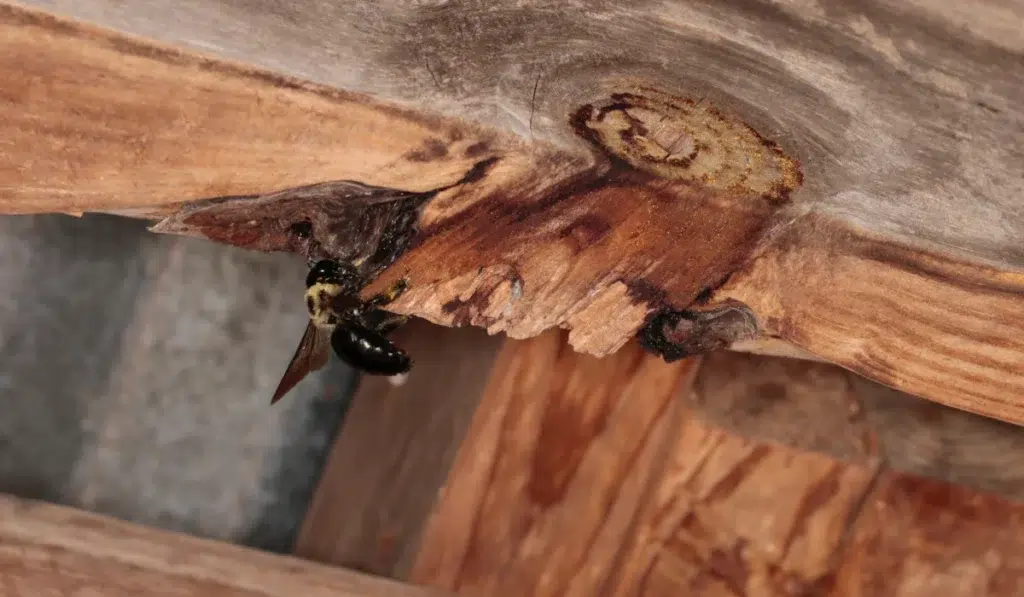
A big bee hovering around your porch can get your attention. Finding a perfectly round hole in the wood nearby is an even better reason to look closer. Those two clues often point to carpenter bee activity.
Carpenter bees in Alabama commonly attract attention around decks, porches, fascia boards, railings, and other exposed wood. They do not eat wood the way termites consume cellulose. Female carpenter bees excavate wood to create protected nesting galleries for their young.
The first signs are easy to overlook. You may see a small pile of coarse sawdust below a board or notice one bee returning to the same opening. Once you understand what carpenter bees look like and how their nests are built, it becomes much easier to tell normal bee activity from a problem developing in your home.
What Do Carpenter Bees in Alabama Look Like?
Carpenter bees are large, heavy-bodied bees, so homeowners often mistake them for bumblebees. From several feet away, the resemblance can be convincing. Both are noticeable insects, and both may have dark bodies with areas of yellow hair.
The abdomen provides a useful distinction. Large carpenter bees generally have a shiny, relatively hairless upper abdomen, while bumblebees tend to look fuzzy across more of their bodies. You do not need to catch the insect to make that comparison. Its behavior around the property often provides an even better clue.
A carpenter bee repeatedly visiting a hole in a porch ceiling or fascia board is showing nesting behavior that you would not expect from a bumblebee. Males may also hover around a nesting area and fly toward people who walk past. That display looks confrontational, but male carpenter bees cannot sting.
| What to compare | Carpenter bee | Bumblebee |
|---|---|---|
| Body shape | Large and heavy-bodied | Large and heavy-bodied |
| Abdomen | Often shiny with less hair on top | Usually much fuzzier |
| Nesting habit | Excavates galleries in wood | Uses existing cavities or underground sites |
| Common clue at a home | Round opening in exterior wood | Regular flights to a cavity or ground nest |
| Male sting | Cannot sting | Cannot sting |
The table is a starting point, not a reason to get within inches of a bee. Watch what it does from a comfortable distance. Nest location and repeated flight patterns can be more useful than trying to inspect tiny markings on a moving insect.
Why Do Carpenter Bees Make Holes in Wood?
Female carpenter bees make holes because wood provides the protected space they need for nesting. The bee uses strong jaws to excavate a passage, then creates areas inside the gallery where offspring can develop. She is removing wood, not eating it for nutrition.
The entrance itself is unusually neat. Alabama Cooperative Extension System describes carpenter bee openings as about 1/2 inch in diameter. After entering the wood, the bee turns and continues excavating with the grain, which means the visible hole shows only a small part of the nest.
Fresh excavation can leave coarse sawdust beneath the entrance. Around an Alabama house, good places to check include fascia, porch ceilings, exposed rafters, deck components, railings, trim, sheds, and fences. Finding both sawdust and repeated bee traffic makes an active gallery more likely than finding an old hole by itself.
What Does Carpenter Bee Damage Look Like?
Early carpenter bee damage can look minor. One clean hole in a thick piece of wood is easy to dismiss, especially when the rest of the board looks normal. The concern grows when the same favorable nesting area is used repeatedly.
Existing galleries can be extended or reused, and several bees may establish nests in the same general section of a structure. Over time, homeowners can find multiple openings, internal tunneling, staining around nest entrances, and weathering around damaged areas. Repeated activity is more meaningful than the appearance of one isolated hole.
This can matter on older homes around Birmingham communities such as Mountain Brook and Vestavia Hills, where porches, trim, and other exterior wood features are common. The goal is not to treat every carpenter bee hole as a structural emergency. It is to recognize when a nesting site has become a recurring problem rather than allowing new galleries to accumulate year after year.
Woodpeckers can make the damage look worse. They may peck into infested wood while searching for developing carpenter bees inside galleries. Their larger gouges and openings are secondary damage, but homeowners may first notice them before realizing insects are present inside the wood.
| What you see | What it can mean | What to check next |
|---|---|---|
| One clean round hole | New or old gallery | Look for fresh sawdust and bee traffic |
| Sawdust below the opening | Recent excavation | Watch for a female entering the hole |
| Several holes in one board | Repeated or multiple nesting | Inspect the full length of the wood |
| Dark staining near holes | Ongoing or previous nest activity | Check for other galleries nearby |
| Larger rough gouges | Possible woodpecker activity | Look for carpenter bee holes around the damage |
These signs help you judge the extent of activity without tearing into the wood. An inspection can then determine which holes are active and whether the same area has been used repeatedly.
Can Carpenter Bees Sting?
Female carpenter bees can sting, but they are not normally chasing people around a yard. They are more likely to sting if they are handled or directly threatened. Giving a nesting female some space is usually enough to avoid that situation.
Males create most of the intimidating behavior homeowners notice. A male may hover near a porch or fly toward someone approaching its territory. He cannot sting because male carpenter bees do not have stingers.
That distinction can make a hovering bee less alarming, but you usually cannot identify the sex of every bee from several feet away. Avoid swatting at them or putting fingers and tools into an active gallery. The nest may contain females even when a territorial male is the insect getting your attention.
When Are Carpenter Bees Active in Alabama?
Carpenter bee activity becomes noticeable when adults begin flying around nesting areas in warm weather. Spring is when many Alabama homeowners start spending more time on decks and porches, so the return of bees around exterior wood tends to be easy to notice.
Females may create new galleries or use suitable existing ones. Inside a gallery, the female creates individual brood cells and provides food for her developing offspring. Young bees remain protected inside the wood while they develop, so there can be much more happening inside a board than the activity at the entrance suggests.
Later, a new generation of adults emerges. Adults can also use protected galleries for shelter during colder periods. Exact activity dates can shift with local weather, so Birmingham and Huntsville homeowners should pay more attention to what is happening around their property than to a fixed date on the calendar.
| Time of year | Typical activity | What homeowners may notice |
|---|---|---|
| Spring | Adults become active and nesting begins | Hovering bees and fresh wood excavation |
| Late spring into summer | Galleries contain developing young | Repeated trips to active nest openings |
| Later warm season | New adults appear | Activity around existing galleries |
| Colder months | Exterior activity declines | Few bees flying around the property |
If your porch had carpenter bee holes last year, that area deserves another look when warm-weather activity returns. Old nesting locations can provide an early clue before fresh damage becomes obvious.
What Types of Wood Attract Carpenter Bees?
Carpenter bees are especially associated with exposed or weathered wood that is suitable for excavation. They can investigate exterior trim, siding, decks, porch components, rafters, fences, and other wooden features around a property.
Wood species also influence nesting. University of Georgia Cooperative Extension identifies woods such as cedar, cypress, pine, and redwood among materials carpenter bees may attack. Painted wood is generally less attractive to them than unfinished wood, making exterior maintenance part of a practical prevention plan.
That does not mean every unfinished board will develop a nest. Location, condition, previous carpenter bee activity, and other site factors matter. An old gallery is particularly worth watching because the same general area may continue attracting activity.
When replacing damaged exterior boards, consider how the new wood will be finished instead of leaving it bare. Keeping vulnerable surfaces painted and maintained is more useful than waiting for a new hole to appear before thinking about prevention.
Should You Fill Carpenter Bee Holes?
A round carpenter bee hole looks easy to fix with a little filler, but first you need to know whether the gallery is active. Fresh sawdust or regular bee traffic tells you more than the appearance of the opening alone.
Closing an occupied gallery without dealing with the active bees does not address what is happening inside the wood. This is why inspection should come before repair. Once active carpenter bee activity has been handled, the damaged area can be repaired and finished as appropriate.
Magic City Pest Control’s service information follows that order. The company’s carpenter bee process begins by addressing the existing holes and then applying a repellent approach intended to discourage continued activity. That allows the pest issue to be addressed before the homeowner treats the hole as a simple cosmetic repair.
If you find several holes, inspect the whole section of wood rather than filling them one at a time as you notice them. Multiple openings can indicate that the location has supported repeated nesting, which calls for a broader look at the wood and surrounding surfaces.
How Can You Prevent Carpenter Bee Damage?
Prevention starts with exterior maintenance. Check fascia, porch ceilings, deck rails, trim, exposed rafters, fences, and sheds for old carpenter bee holes or weathered wood. Previous nesting sites deserve special attention when bees become active again.
Painting exposed wood can make it less attractive for nesting. Repairing deteriorated surfaces also removes some of the easy opportunities carpenter bees find around older exterior wood. Magic City’s own homeowner guidance recommends maintaining or finishing wood and dealing with old openings as part of prevention.
Timing helps too. If you already know carpenter bees favor one side of the porch, do not wait until several fresh piles of sawdust appear before checking it. A quick seasonal inspection lets you identify new activity while it is still concentrated.
No home-maintenance step guarantees that carpenter bees will never visit your yard. They are outdoor pollinators, and seeing one feeding at flowers is different from finding an active gallery in your house. Prevention should focus on protecting the wood, not eliminating every carpenter bee from the property.
Dealing With Carpenter Bees Around Your Alabama Home
Carpenter bees are easier to deal with once you separate normal bee activity from nesting in the structure. A shiny abdomen can help with identification, but a round entrance, fresh sawdust, and repeated flights to the same piece of wood provide much stronger evidence that a gallery is active.
If carpenter bees in Alabama are returning to your porch, deck, fascia, or other exterior wood, Magic City Pest Control can inspect the affected areas and determine how to address the existing activity. The company serves Birmingham, Huntsville, and surrounding Alabama communities. Contact Magic City Pest Control to schedule an inspection and deal with the nesting activity before making repairs.