

Spotting a large stinging insect around your porch, roofline, or backyard can leave you with a basic question: What exactly is it? When people talk about hornets in Alabama, they may be referring to several different social wasps. Some build large paper nests in trees. Others disappear into hollow trees or protected openings where the nest stays out of sight.
The names can make identification even more confusing. European hornets are true hornets, while bald-faced hornets are actually a type of yellowjacket. Paper wasps and other yellowjackets can also get called hornets because homeowners notice similar colors, flight patterns, or nesting activity.
Knowing what you are looking at helps you make a better decision about the nest. Below, you will find practical ways to distinguish common hornet-like insects, understand when colonies are active, recognize sting risks, and decide when a nest near your Alabama home needs attention.
What types of hornets are found in Alabama?
When determining which hornets are present around a property, homeowners should pay close attention to two primary species: the bald-faced hornet and the European hornet. They are both social wasps, but they look different and tend to choose different nesting locations.
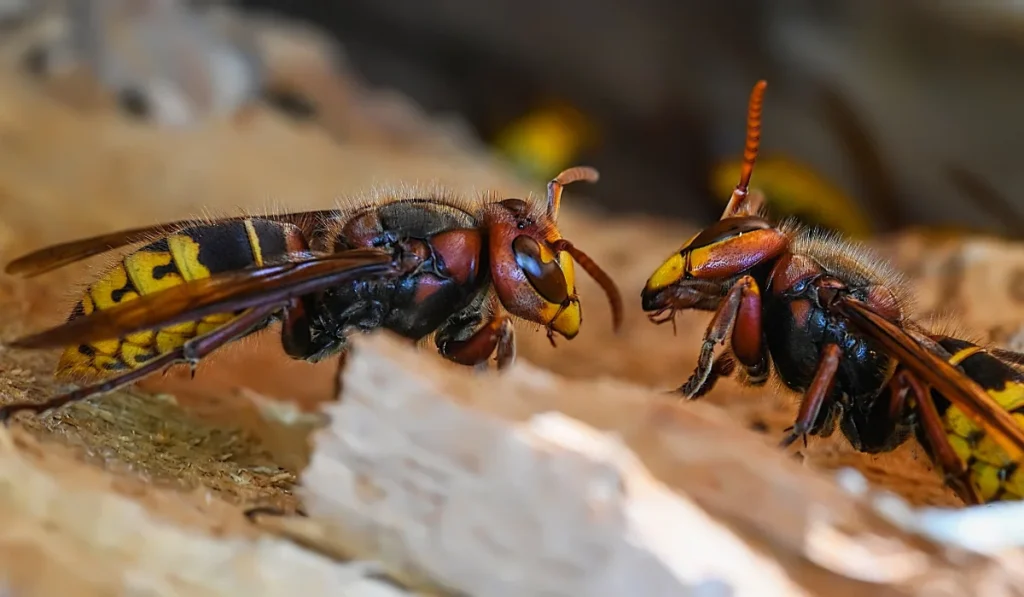
The European hornet, Vespa crabro, is a true hornet. It has a reddish-brown head and thorax with yellow and brown markings on the abdomen. Instead of building a large exposed nest on a branch, these hornets typically use protected cavities. The University of Florida IFAS describes hollow trees as common nesting sites, although suitable structural cavities can also attract colonies.
A bald-faced hornet, Dolichovespula maculata, is not technically a true hornet. It belongs to the yellowjacket group. Its black body and contrasting white markings make it look quite different from the European hornet. Bald-faced hornets construct the gray, enclosed paper nests that you may find hanging from trees, shrubs, or structures.
| Identification clue | European hornet | Bald-faced hornet |
|---|---|---|
| Classification | True hornet | Yellowjacket |
| Typical coloring | Reddish-brown and yellow | Black and white |
| Nest style | Usually concealed in a cavity | Enclosed paper nest |
| Common nest locations | Hollow trees and protected cavities | Trees, shrubs, and structures |
| Nest visibility | Often difficult to see | Often visible as the nest grows |
Those differences matter because the nest you see can tell you almost as much as the insect itself. A large gray paper nest hanging from a branch does not point to the same species as large wasps repeatedly flying into a hollow tree.
Hornets vs. wasps: What is the difference?
Hornets, yellowjackets, and paper wasps, told apart
People call a lot of stinging insects “hornets” around Birmingham and Huntsville. Here is what each one actually looks like, where it tends to nest, and what that means if you find one.
All true hornets are wasps, but the word “wasp” covers a much larger group of insects. Around an Alabama home, you may encounter European hornets, bald-faced hornets, yellowjackets, and paper wasps. Calling all of them hornets makes it harder to understand their nesting behavior.
You do not need to get close enough to inspect tiny markings. Start with the insect’s general color, nest shape, and nesting location. A paper wasp colony usually creates an exposed comb where individual cells remain visible. Bald-faced hornets cover their combs inside a protective paper envelope. European hornets usually keep the nest itself hidden inside a cavity.
| Insect | What you may notice | Typical nest | Common nesting area |
|---|---|---|---|
| European hornet | Large body with reddish-brown and yellow coloring | Concealed nest | Hollow trees or other cavities |
| Bald-faced hornet | Black body with white markings | Enclosed gray paper nest | Trees, shrubs, or structures |
| Yellowjacket | Compact body, commonly black and yellow | Concealed paper nest | Ground cavities or protected voids |
| Paper wasp | Slender body with long legs | Open paper comb | Eaves and other sheltered surfaces |
If you cannot identify the insect from a safe distance, watch its flight path instead of moving closer. Several insects repeatedly entering the same opening can reveal an active nesting site even when the nest itself is hidden.
Where do hornets in Alabama build nests?
The nesting site depends heavily on the species. Hornets may establish colonies around trees, shrubs, wooded edges, sheds, rooflines, and other sheltered areas. Some nests are obvious. Others remain almost completely hidden.
Bald-faced hornets construct enclosed paper nests that usually become easier to notice as the colony grows. You might find one attached to a tree branch, large shrub, overhang, or another elevated surface. The nest has a layered gray appearance because the insects make its covering from chewed plant fibers.
European hornets take a different approach. They favor enclosed spaces such as hollow trees and other cavities. That means you may notice the traffic before you ever see the nest. If several large wasps keep entering the same opening, avoid plugging or covering it while the colony is active.
Location also affects how much of a problem a nest creates. A colony well away from regular activity is different from one beside a porch, play area, driveway, walkway, or business entrance. The closer the nest is to normal foot traffic, the greater the chance that someone will accidentally disturb it.
When are hornets most active in Alabama?
Hornet colonies do not begin the season at full size. Social wasps generally start with a queen establishing a nest. As workers develop, they take over food gathering, nest construction, and colony defense. The amount of visible activity increases as the colony grows.
This is why a hornet nest can seem to appear suddenly even though it has been developing for some time. A small spring nest can be easy to overlook. Later in the warm season, increased worker traffic and a larger nest make the colony much easier to notice.
| Part of the season | What is happening in the colony | What you may notice |
|---|---|---|
| Spring | A queen begins establishing a new colony | Very little visible activity |
| Early summer | Workers develop and expand the nest | More regular flights around the nest |
| Late summer into early fall | Colony reaches a larger size | Heavy traffic and a more noticeable nest |
| Cold weather | Annual colony declines | Activity drops sharply |
The exact timing varies with species and weather conditions. What matters most for homeowners is that a nest with heavy late-season activity may contain a much more developed colony than the small nest that existed earlier in the year.
Do hornets sting?
Yes. Hornets can sting when defending themselves or their colony, and social wasps may react strongly when activity occurs close to the nest. Mowing beside a concealed nesting site, trimming a shrub containing a paper nest, or working around an active cavity can bring you closer than you intended.
Unlike a honey bee worker, a hornet does not have to leave its stinger behind after a single sting. It can sting repeatedly. Most stings cause immediate pain along with redness and swelling near the site, although the severity of a person’s reaction varies.
The larger medical concern is a serious allergic reaction. Symptoms such as difficulty breathing, swelling of the tongue or throat, fainting, or severe dizziness require emergency medical care. If you know that you have a serious allergy to stings, approaching an active hornet nest to identify it is an unnecessary risk.
Deaths from stinging insects are uncommon, but national data show why allergic reactions deserve attention. A CDC National Center for Health Statistics report recorded 788 deaths in the United States from hornet, wasp, and bee stings between 2011 and 2021, averaging 72 deaths per year. The statistic combines all three insect groups and covers the entire United States, so it should not be interpreted as an Alabama hornet death count.
What should you do if you find a hornet nest?
Start by leaving the nest alone. You can usually gather useful information without standing underneath it, shaking the branch, opening a wall cavity, or getting close enough to photograph individual insects. Note the nest location and watch from a safe distance to see where insects enter and leave.
Think about what happens around that location during a normal day. A nest next to the front door presents a different problem from one at the far edge of a wooded lot. Pay particular attention to nests near decks, sidewalks, children’s play areas, lawn equipment routes, pet areas, and doors used by customers or employees.
Avoid trying to knock down an active paper nest. You should also avoid digging into a suspected ground nest or sealing an entrance that active wasps are using. These actions disturb the colony at close range. With a concealed nest, blocking one visible opening can also cause insects to search for another route.
Professional help becomes more useful when the nest is high, hidden, difficult to identify, or located where people cannot reasonably avoid it. Magic City Pest Control technicians handle bee, wasp, and hornet problems and can address activity around foliage and the exterior of the home. The company can also treat eaves up to 25 feet when needed.
How can you make your property less attractive to hornets?
You cannot keep every wasp or hornet from flying through your yard. They are outdoor insects, and some prey on other insects. Prevention is more about limiting nesting opportunities and reducing attractants close to the places where your family spends time.
Check the exterior of your home for gaps around siding, rooflines, vents, utility penetrations, and similar openings. Seal suitable openings before a colony occupies them. If insects are already moving through an opening, identify and address the active nest first rather than sealing them inside.
Look beneath eaves, porch roofs, deck railings, sheds, and other protected surfaces from time to time during warmer months. Finding a developing exposed nest early gives you more options than discovering a mature colony beside a busy doorway later in the season.
Outdoor sanitation helps as well. Keep trash containers closed, clean up food after outdoor meals, and remove fallen fruit around fruit trees. These simple habits reduce food sources that can attract several types of social wasps to the areas where people gather.
When should you call for hornet control in Alabama?
Professional hornet control in Alabama makes sense when a colony is established where people regularly pass or when you cannot safely determine what is nesting on the property. Hidden nests, elevated nests, and colonies near entrances can be difficult to evaluate without the right equipment and experience.
Identification should come before treatment. A bald-faced hornet nest hanging from a tree calls for a different assessment than European hornets using a concealed cavity or yellowjackets entering the ground. Knowing the species and nest location helps determine how the situation should be handled.
There is also no benefit in turning a manageable nest into a defensive colony by testing home remedies at close range. If the nest is difficult to reach, activity is heavy, or someone on the property has a history of severe sting reactions, keep your distance and have a pest professional inspect the situation.
Get help with hornets in Alabama
Hornets around an Alabama property are easier to deal with once you know what you are seeing. Body markings provide clues, but nest shape, location, and flight activity often tell you more. Those details can help separate a European hornet from a bald-faced hornet, yellowjacket, or paper wasp without requiring you to get close to the nest.
If hornets have established a colony near your home or business, Magic City Pest Control can inspect the activity and determine the appropriate approach. Our technicians handle wasp and hornet problems around homes, foliage, and elevated eaves. Contact Magic City Pest Control to schedule service in the Birmingham or Huntsville service area.