

Turn on a bathroom light late at night and you might catch something with a lot of legs racing toward the baseboard. It moves fast, looks strange, and disappears before you get much of a look. In many homes, that unexpected visitor is a house centipede.
Alabama centipedes include different species that live outdoors and around buildings, but house centipedes get plenty of attention because they can live indoors. They favor protected areas and feed on other small arthropods. That means seeing one in your house raises a more useful question than simply how to remove it: What is allowing centipedes to live there?
An occasional centipede can wander indoors without signaling a larger problem. Regular sightings deserve a closer look. Moisture, entry points, shelter, and other pest activity can all contribute to conditions that keep centipedes around.
What Do Centipedes in Alabama Look Like?
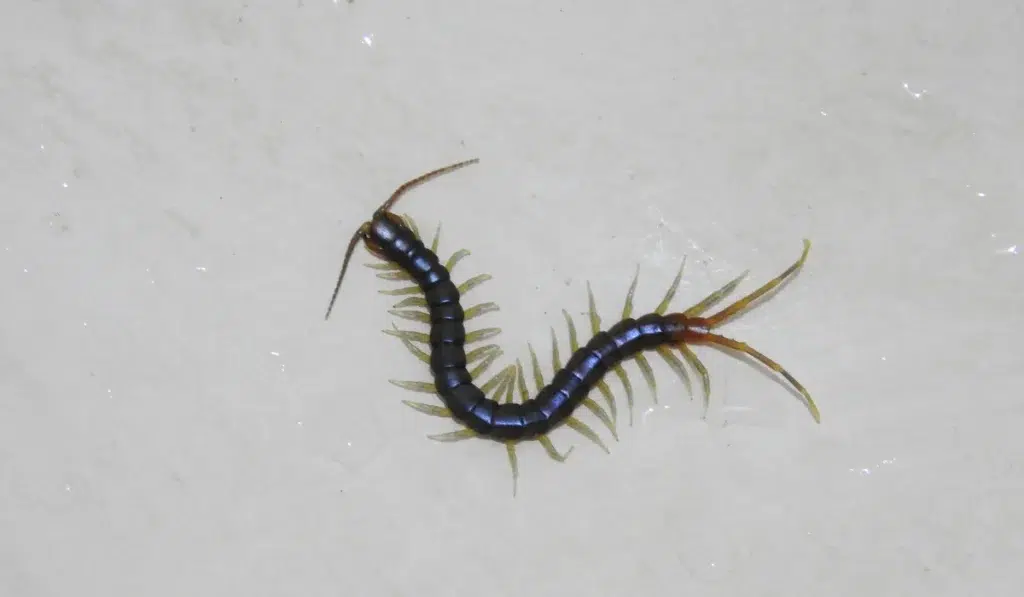
Centipedes have long, segmented bodies with one pair of legs attached to each leg-bearing body segment. They also have a pair of antennae and specialized appendages near the head that help them capture prey. Their appearance varies by species, so not every centipede you find around an Alabama property will look like the long-legged house centipede.
House centipedes are particularly distinctive. Adults have 15 pairs of legs, for a total of 30, with the rear legs becoming especially long. Their legs can make the animal look much larger than its actual body. House centipedes are also quick runners, which is why homeowners often get only a brief look before the centipede reaches cover.
The Alabama Cooperative Extension System is a useful local resource for identifying household and structural pests found around Alabama homes. Identification matters because centipedes, millipedes, silverfish, and other crawling arthropods can be confused when they are spotted for only a few seconds.
| Feature | House centipede | Other centipedes |
|---|---|---|
| Body | Narrow and segmented | Segmented, often heavier-looking |
| Legs | 15 pairs in adults | Number varies by species |
| Leg appearance | Very long and slender | Often shorter relative to the body |
| Movement | Fast, especially when disturbed | Varies by species |
| Common indoor clue | Runs across floors or walls | Often associated with damp, protected areas |
The location can provide another clue. House centipedes are more likely to get noticed inside buildings, while other centipedes are commonly found outdoors beneath logs, stones, leaves, landscaping materials, and other sheltered areas.
Centipede vs. Millipede: What Is the Difference?
Centipedes and millipedes are frequently confused, but a close look reveals several differences. Centipedes are generally flatter and faster. They are predators that hunt other small animals, while millipedes usually feed on decaying plant material and other organic matter.
The legs offer one of the easiest ways to tell them apart. Centipedes have one pair of legs on each leg-bearing body segment. Millipedes generally have two pairs on most apparent body segments. Millipedes also tend to have more rounded or cylindrical bodies and often curl into a tight coil when disturbed.
| Feature | Centipede | Millipede |
|---|---|---|
| Legs | One pair per leg-bearing segment | Usually two pairs per apparent segment |
| Body shape | Generally flatter | Usually rounded or cylindrical |
| Movement | Often quick | Usually slower |
| Diet | Predator | Mostly decaying organic material |
| Defense | Tries to escape and can use venom against prey | Often curls into a coil |
| Typical home concern | Indoor sightings and prey activity | Large numbers wandering indoors |
The name “centipede” can be misleading too. It comes from words referring to 100 feet, but centipedes do not all have 100 legs. In fact, centipedes have an odd number of pairs of walking legs, so an individual centipede cannot have exactly 100 legs.
Why Are House Centipedes Inside Your Alabama Home?
Finding a house centipede in Alabama often has more to do with the conditions inside or around the building than with the centipede itself. These predators need suitable shelter and food. Areas with moisture and other small arthropods can provide both.
Bathrooms, basements, crawl spaces, garages, laundry areas, and utility rooms deserve attention when sightings become regular. A leaking pipe, persistent dampness, or gaps around plumbing can create favorable conditions. Alabama’s humidity can make moisture management especially relevant in crawl spaces and other enclosed parts of a home.
Food matters just as much. House centipedes prey on other small arthropods, so repeated centipede sightings can be a reason to look for additional pest activity. Removing the centipede you see may solve that night’s surprise, but it does not explain why predators are finding enough resources to remain indoors.
| Where centipedes appear | What may be contributing | What to inspect |
|---|---|---|
| Bathroom | Moisture and easy hiding places | Plumbing, gaps, damp cabinets and baseboards |
| Basement or crawl space | Humidity and shelter | Moisture conditions and other pest activity |
| Garage | Exterior access and clutter | Door gaps, wall openings and stored materials |
| Laundry or utility room | Water sources and protected spaces | Pipes, drains and nearby cracks |
| Living areas | Entry routes or available prey | Baseboards, adjoining rooms and wall gaps |
One sighting does not prove there is a serious moisture problem or another infestation. Patterns are more informative. If centipedes keep turning up in the same room, look at what that area provides rather than treating each sighting as an unrelated event.
What Do House Centipedes Eat?
House centipedes are predators. They hunt small arthropods rather than feeding on wood, clothing, furniture, or stored food. This makes them very different from household pests that directly damage belongings or structural materials.
Their prey can include insects and other small arthropods they are able to overpower. A house centipede uses its speed to pursue prey and specialized structures near its head to subdue it. This predatory lifestyle helps explain why the presence of other pests can influence where centipedes remain active.
Seeing centipedes does not mean you should keep them around as a household pest-control program. Repeated indoor activity is more useful as information. It tells you to inspect for moisture, access points, and potential prey rather than focusing only on the animal running across the floor.
Do Centipedes Bite People?
Centipedes are equipped to capture prey, and they have modified appendages called forcipules that can deliver venom. These structures are sometimes described as venom claws. They are used primarily for hunting rather than seeking out people.
House centipedes generally try to escape when disturbed. Contact with people can occur, particularly if a centipede is handled, trapped against the skin, or otherwise unable to get away. The sensible approach is to avoid picking one up with bare hands.
Auburn University Department of Entomology and Plant Pathology provides Alabama-based entomology resources that can help homeowners understand local arthropods without relying on alarming claims from general pest websites. If any bite or sting causes a severe or unusual reaction, contact a medical professional for advice rather than relying on pest identification alone.
Does Seeing One Centipede Mean You Have an Infestation?
One centipede does not automatically mean dozens more are hiding behind the walls. Outdoor centipedes can wander inside, and even a house centipede sighting does not tell you the size of a population by itself.
Frequency changes the picture. Seeing centipedes regularly in the same bathroom, basement, crawl space, or utility area gives you more reason to investigate. The useful questions are where you see them, how often they appear, whether the area stays damp, and whether other insects or arthropods are present.
This is also why counting centipedes is not always the best measure of the problem. A predator depends on suitable conditions and available prey. Correcting those conditions can be more effective over the long term than repeatedly dealing with individual centipedes as they appear.
Pay attention to timing as well. A sudden outdoor weather change may push occasional pests toward a structure, while steady indoor sightings over a longer period suggest that conditions inside deserve a closer inspection.
How Are Centipedes Getting Into the House?
Centipedes do not need a large opening to move inside. Gaps beneath exterior doors, cracks around the foundation, utility penetrations, openings around plumbing, and poorly sealed windows can provide access.
Garages and crawl spaces can act as transition areas. A centipede may enter one of these spaces from outdoors and later move farther into the house. Openings around pipes and wiring can also connect protected spaces that homeowners rarely see.
Outdoor conditions near the foundation matter too. Leaf litter, dense ground cover, stones, stacked materials, and other objects can create damp hiding places for centipedes and the arthropods they eat. Keeping these materials from piling directly against the house reduces shelter immediately beside potential entry points.
The goal is not to make an Alabama yard unsuitable for every centipede. These animals are part of the outdoor environment. Prevention should focus on reducing the routes and conditions that encourage them to move indoors.
How Can You Reduce Centipedes Around Your Home?
Start with moisture. Check plumbing for leaks and look for areas that remain damp long after they should have dried. Bathrooms, laundry rooms, basements, crawl spaces, and utility areas are sensible places to begin when centipede activity keeps occurring indoors.
Next, look at access. Repair damaged weather stripping, improve door sweeps, and seal appropriate cracks and gaps around exterior openings. Openings around pipes, cables, vents, and utility lines can be easy to miss during a quick walk around the house.
Outdoor maintenance can reduce shelter near the foundation. Keep excessive leaf litter, debris, and stored materials from building up directly against the structure. If drainage leaves an area beside the home consistently wet, correcting that condition can help make the location less favorable for many moisture-associated pests.
Finally, pay attention to other pest activity. Because house centipedes are predators, reducing their available prey addresses one of the reasons they can remain in a building. This is where a broader pest inspection can be more useful than treating centipedes as an isolated problem.
Managing Alabama Centipedes Around Your Home
An occasional centipede is often just an unwanted visitor. Repeated sightings tell you more. They can point toward moisture, entry gaps, sheltered areas, or other pest activity that deserves attention, especially when the same rooms keep producing sightings.
If centipedes are becoming a regular problem in your home, Magic City Pest Control can inspect the property and look beyond the individual centipedes you happen to see. Our team serves Birmingham, Huntsville, and surrounding Alabama communities. Contact Magic City Pest Control to schedule service and find out what may be supporting centipede activity around your home.