

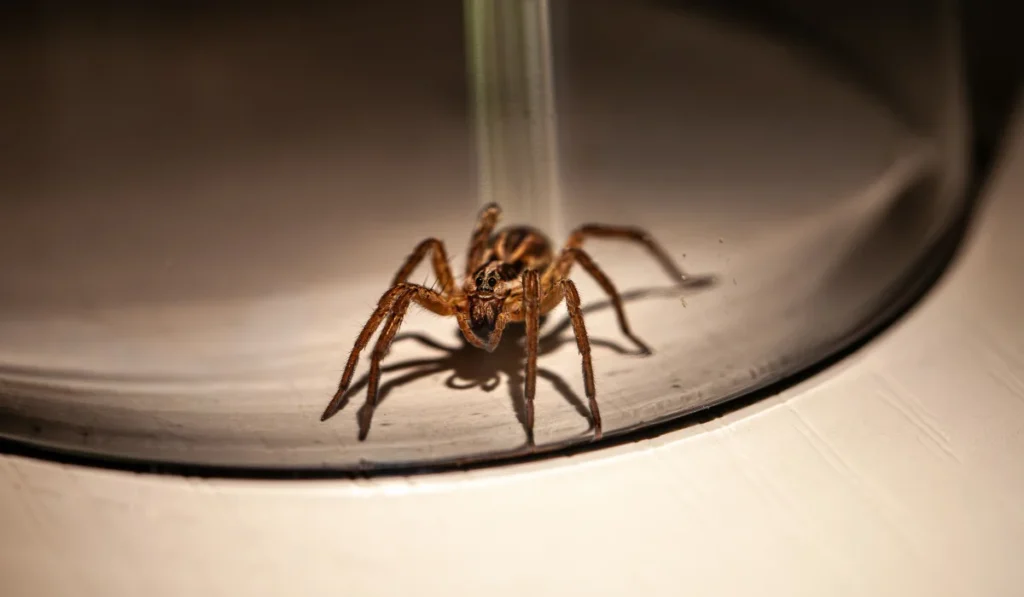
Wolf spiders in Alabama are active hunting spiders that can turn up in garages, basements, patios, and living spaces. If you searched “wolf spider Alabama” after finding one indoors, start with its eye pattern, body shape, and behavior rather than its brown coloring or size. Wolf spiders can bite when handled or trapped against the skin, but seeing a large brown spider does not automatically mean you found a brown recluse. Here is how to identify a wolf spider, understand why it may be inside, and decide what to do if sightings continue.
Wolf Spider Alabama Identification: What to Look For
Wolf spiders generally have brown or gray coloring that blends well with soil, mulch, leaves, and other outdoor surfaces. Their exact markings vary, which is one reason several spiders in Alabama can look alike when viewed quickly or in poor lighting.
The World Spider Catalog places wolf spiders in the family Lycosidae. According to the University of Kentucky Entomology wolf spider guide, they actively hunt for prey rather than depending on a capture web. That ground-hunting behavior is often one of the first useful clues when a spider runs across a garage floor, patio, or basement.
Check the Eyes
Wolf spiders have eight eyes arranged in three rows, including two relatively large forward-facing eyes. The eye pattern gives you a more useful identification feature than color alone.
You do not need to handle a spider to inspect it. If the spider remains still, a clear photo taken from a safe distance may capture enough of the body and eye area to help with identification.
Watch How the Spider Moves
A wolf spider usually moves on foot while hunting instead of remaining in the middle of a prey-catching web. Movement alone cannot identify a spider, but it adds useful context when combined with the eye arrangement and overall body shape.
Size is less helpful than many homeowners expect. Wolf spiders belong to a large family, so individual spiders can differ in size, shade, and markings. “Large brown spider” is a starting description, not an identification.
Wolf Spider vs. Brown Recluse: What Should You Compare?
The quickest mistake to avoid is identifying a brown recluse by color alone. Brown is common among spiders, and lighting can make markings difficult to see. If you are deciding whether a spider is a wolf spider, look for the wolf spider’s verified features instead of trying to match it to a vague picture of a “brown spider.”
An eight-eye pattern arranged in three rows, combined with active ground hunting, supports a wolf spider identification. If you cannot see those features clearly, do not handle the spider just to get a closer look.
Basements, garages, and utility areas can contain several kinds of spiders. Even among common basement spiders in Birmingham, location by itself does not tell you which species you found. A clear photo or professional identification is more useful than guessing from where the spider appeared.
Do Not Identify the Spider From a Bite Mark
A skin mark does not give you the same information as seeing and identifying the spider itself. If you never saw the spider, assigning a species to a bite based only on appearance can lead you in the wrong direction.
If you are concerned about a suspected spider bite or a skin reaction, seek medical advice. Skin changes associated with a suspected brown recluse bite are a separate issue from identifying a live wolf spider in your home.
Are Wolf Spiders in Alabama Dangerous?
Wolf spiders use venom to subdue prey, but homeowners are more likely to be concerned about whether the spider will bite them. Wolf spiders can bite when handled, trapped, or pressed against the skin, so avoid picking one up with your bare hands.
Fast movement can make a wolf spider seem aggressive when it crosses an open floor. Speed does not show that the spider is pursuing a person. Wolf spiders are active hunters, and their movement through open areas is part of that hunting behavior.
If you need to remove an unfamiliar spider, keep your hands away from it. When identification is uncertain, a photograph is more useful than trying to capture the spider by hand.
Why Do Wolf Spiders Come Into Alabama Homes?
A single wolf spider indoors may simply have moved through an available opening. Recurring sightings deserve more attention because they can point to a dependable entry route, regular prey activity, or sheltered areas around the structure.
Wolf spiders hunt other small creatures, so places with steady insect activity can also support hunting spiders. Porch areas, garages, foundation edges, and exterior doors can bring shelter, prey, and access together in a relatively small area.
Entry Points Matter
Worn door sweeps, damaged screens, garage-door gaps, and openings around exterior penetrations can give wandering spiders a route indoors. If several sightings occur near the same wall, doorway, or room, inspect that part of the structure first.
Garages deserve particular attention because the main door opens directly to the outdoors and the space often connects to the rest of the home. Gaps along the door edges or lower corners can provide an easy path inside.
Prey Activity Can Keep Spiders Nearby
Outdoor lights can draw insects close to doors and windows. Leaf litter, dense vegetation, and sheltered areas near the foundation can also support small pests that wolf spiders hunt.
Finding a wolf spider does not prove that you have a large insect infestation. Repeated spider activity is more useful as a clue when it appears alongside visible insects, recurring webs from other spiders, or obvious exterior conditions that support pests.
Do Wolf Spiders Build Webs?
Wolf spiders do not rely on prey-catching webs. NC State Extension’s wolf spider information describes them as hunters that move in search of prey.
They still use silk. Reproduction is one of the clearest examples, and two wolf spider behaviors often surprise homeowners: females carrying egg sacs and spiderlings riding on the female after hatching.
Why Is a Wolf Spider Carrying an Egg Sac?
Female wolf spiders carry their egg sacs attached to the spinnerets. Instead of leaving the egg sac behind in a stationary web, the female moves with it.
A rounded sac attached behind the abdomen may therefore be part of the spider’s reproductive behavior rather than debris caught on its body.
Why Are Baby Wolf Spiders on the Female’s Back?
After hatching, young wolf spiders can ride on the female’s abdomen for a period. From a distance, her back may appear covered with many tiny dots.
Crushing a female carrying spiderlings can cause them to separate in the immediate area. If you encounter one indoors, avoid swatting it and use a removal method that does not require handling the spider directly.
What Attracts Wolf Spiders Around Alabama Homes?
Wolf spiders benefit from areas that provide prey and shelter. Around a home, that can include dense vegetation, leaf litter, clutter near exterior walls, and other protected spaces where small insects remain active.
Exterior lighting can also affect where prey gathers. A fixture beside a frequently used door may concentrate flying insects near an entrance, giving hunting spiders a reason to remain in the same area.
Moist conditions can support some of the insects spiders hunt. If water regularly collects next to the house, correcting drainage problems can make that part of the property less favorable to several pests, not just spiders.
How to Keep Wolf Spiders Out of Your Alabama Home
Start with the structure. Check door sweeps, screens, garage-door edges, foundation gaps, and openings around pipes or other exterior penetrations. Sealing practical entry points reduces the number of routes wandering spiders can use.
Keep the area immediately around the house easy to inspect. Trimming vegetation away from exterior walls and removing accumulated leaves or clutter are practical parts of spider prevention in Alabama homes because they reduce sheltered areas near common entry points.
Reduce Shelter Around the Foundation
Branches and dense plants touching the house can make the perimeter harder to inspect. Move unnecessary materials away from exterior walls, and keep garage and storage areas organized enough that wall edges and floor corners remain visible.
Mulch does not need to be removed from the landscape. The goal is to avoid creating thick, difficult-to-inspect shelter directly against the structure.
Pay Attention to Exterior Lighting
Outdoor lighting serves a purpose, but insects gathering around fixtures can create feeding opportunities for hunting spiders. If a particular entrance has heavy insect activity at night, review the placement of nearby lights.
You do not need to eliminate outdoor lighting. Focus on avoiding a concentrated feeding area directly beside doors, windows, or other obvious entry points.
Recheck the Exterior After Wet Weather
Changes in moisture and shelter can affect spider activity during Alabama’s rainy season. If you begin seeing more spiders indoors after wetter conditions, inspect door seals, garage edges, foundation gaps, and sheltered exterior areas.
This gives you a specific place to start instead of treating each indoor spider as an unrelated event.
When Does Professional Wolf Spider Control Make Sense?
Professional service becomes more useful when wolf spider sightings keep returning, you are seeing several kinds of spiders around the structure, prey insects are active near entry points, or you cannot confidently identify what you found. Those patterns give a technician more to inspect than a single isolated spider.
Magic City Pest Control’s regular service process includes brushing the building to remove spider webs while inspecting exterior conditions such as branches touching the home, mulch beds near the foundation, and gaps or holes. Looking at those conditions helps address why pest activity is recurring instead of focusing only on the spider that happens to be visible.
If entry points and prey remain available, removing one wolf spider does not prevent another from using the same area. Inspection, exclusion, and attention to surrounding pest activity provide a more complete approach.
Making the Right Spider Control Choice for Your Alabama Home
Wolf spiders are active hunters, and the best identification clues are their eye arrangement, movement, and overall body characteristics rather than brown coloring alone. One spider indoors may be an isolated visitor, but repeated sightings can justify a closer look at entry points, shelter, and prey activity around the structure.
If spiders continue showing up around your property, Magic City Pest Control can inspect the areas where activity is occurring and identify conditions that may be contributing to the problem. To request service, ask about recurring spider activity, or get help with identification, contact Magic City Pest Control to discuss your home.