

Carpenter ants in Alabama become a concern when large ants keep turning up indoors, winged ants appear inside, or coarse sawdust-like debris collects below wood. These ants remove wood to create nesting galleries, while termites consume cellulose. The key is knowing which signs matter, how to tell carpenter ants from termites, and when recurring activity points to a nest that needs closer attention.
What Are the Signs of Carpenter Ants in Alabama?
Repeated activity in the same area matters more than a lone ant. A worker crossing a patio or kitchen floor may be foraging from an outdoor nest. A steady trail, recurring indoor sightings, winged ants, or debris below wood gives you more reason to investigate.
Watch the route the ants take. Workers may travel along foundations, window frames, plumbing lines, siding, deck components, roof edges, or vegetation touching the house. Alabama homes can host several ant species, and the common ants found in Alabama differ in size, nesting habits, and where homeowners tend to notice them.
Sawdust-Like Debris Near Wood
Carpenter ants remove wood as they open and maintain nesting galleries. The debris pushed out of a nest, often called frass, can resemble coarse sawdust and may contain wood fragments along with other nest material.
Frass is most useful when it appears with other signs. Sawdust beneath trim, decks, windows, or other wooden features can have several causes, including repairs and weathering. University of Kentucky Entomology identifies excavated galleries and nesting activity as characteristic features of carpenter ant infestations, so the location of the debris and the presence of ants both matter.
Winged Ants Indoors
Winged carpenter ants are reproductive members of a mature colony. Several appearing indoors, particularly from the same crack, wall area, or window, can indicate an established colony nearby.
Identification comes first because termite swarmers can look similar from a distance. Antennae, body shape, and wing proportions provide better clues than color alone.
What Do Carpenter Ants Look Like?
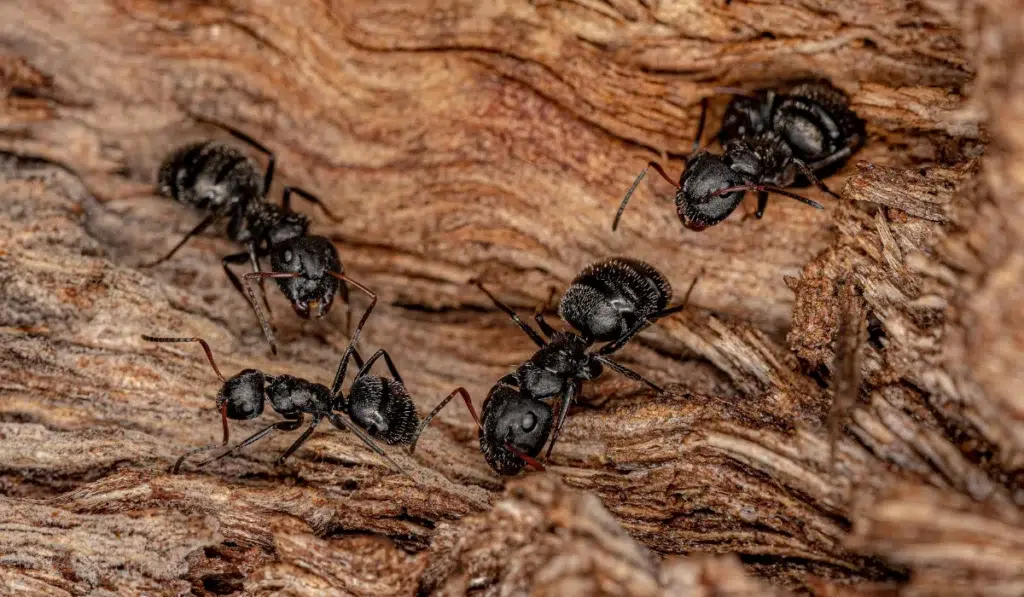
Carpenter ants are generally larger than many household ants, although worker size varies within a colony. Their color can vary too, so a large, dark ant should not be identified by color alone.
More useful features include a narrow, constricted waist and elbowed antennae. Workers do not have wings. Reproductive carpenter ants develop wings when they leave a mature colony to mate and start new colonies.
Why Correct Identification Matters
The species affects where you look for the source. Ants feeding around a countertop may be traveling from another room, an exterior nesting site, or a hidden area of the structure.
One large ant indoors also tells you very little about the condition of the wood. Carpenter ants can forage inside from an outdoor nest, which makes the pattern of activity more useful than a single sighting.
Carpenter Ants vs. Termites: What Is the Difference?
Carpenter ants and termites are both associated with wood, but their body structure and feeding behavior are different.
| Feature | Carpenter Ants | Termites |
|---|---|---|
| Waist | Narrow and constricted | Broad and less constricted |
| Antennae | Elbowed | Straighter |
| Wings on Reproductives | Front wings are larger than rear wings | Front and rear wings are similar in size |
| Relationship With Wood | Remove wood to create nesting galleries | Consume cellulose |
| Possible Structural Clues | Galleries and excavated debris | Subterranean termites may build mud tubes |
The biggest practical difference is what the insect is doing to the wood. Carpenter ants excavate space for the colony. Termites use cellulose as food. The visible differences between flying ants and termites are especially useful when winged insects appear around windows, doors, or lights.
What the Galleries Tell You
Carpenter ant galleries are spaces excavated for nesting. University of Kentucky Entomology describes carpenter ants as removing wood from their nesting sites rather than feeding on the wood itself.
Termite activity involves feeding on cellulose, so the cause of the damage is different. Wood appearance alone should not determine the diagnosis. The insect, the location of the activity, and the surrounding wood condition all need to be considered.
Why Are Carpenter Ants Coming Into Your Home?
Carpenter ants enter homes while foraging or moving between nesting areas. Some workers found indoors originate from an outdoor colony, and carpenter ant colonies can also maintain secondary, or satellite, nests away from the main colony.
That makes the ants’ travel pattern useful. A repeated route along a foundation, tree branch, utility line, deck connection, or exterior opening may point toward the direction of the nest even when the nest itself is hidden.
Moisture-Damaged Wood Can Favor Nesting
Moisture should be one of the first conditions you check when carpenter ants repeatedly appear around the same part of a house. University of Minnesota Extension identifies damp or moisture-damaged wood as a common nesting location for carpenter ants.
Problem areas can include wood affected by roof leaks, plumbing leaks, damaged window frames, poor exterior drainage, or persistent crawlspace moisture. Carpenter ants may also extend galleries into firmer wood after establishing a nest, so drying an area does not remove a colony that is already present.
Outdoor Nesting Sites Can Feed Indoor Activity
Dead wood, tree stumps, firewood, and other suitable wood around a property can support carpenter ant nests. Workers can travel from these areas onto the house and enter through gaps while searching for food.
When ants keep coming back in Alabama homes, recurring workers may be a sign that the source has not been addressed. Following the route and checking nearby nesting conditions gives you more useful information than removing each worker as it appears.
Can Carpenter Ants Damage Your Home?
A carpenter ant colony can damage the wood it occupies by enlarging nesting galleries over time. The ants are not feeding on that wood, but continued excavation can affect wooden components where the colony remains active.
The amount of damage cannot be judged from one ant sighting. A worker entering from a tree or stump is a different situation from a colony established in a wall, roof area, window frame, or another wooden part of the house.
Moisture Damage May Already Be Present
Carpenter ants are often associated with wood that has been softened or damaged by moisture. Penn State Extension identifies moisture problems as an important condition to investigate when carpenter ants are found in buildings.
This can leave homeowners with two issues to address: the ant colony and the water or wood problem that created favorable nesting conditions. A roof leak, plumbing leak, damp crawlspace, or damaged window assembly may require repair regardless of how much excavation the ants have caused.
Signs That Warrant a Closer Inspection
Several clues together are more meaningful than one sign by itself:
- Carpenter ants repeatedly appear in the same indoor area.
- Workers follow a consistent route into or out of the structure.
- Frass collects beneath a crack, gap, or wooden component.
- Several winged ants appear indoors.
- Ant activity is concentrated around damp or deteriorated wood.
These patterns can help separate occasional foraging from activity that may involve a nest in or near the structure.
How Do You Get Rid of Carpenter Ants in Alabama?
Carpenter ant control starts with the source. Removing workers from a counter or floor may reduce visible activity, but workers outside the nest do not tell you whether the colony has been addressed.
Trace where the ants are entering and traveling. Check the surrounding area for moisture, deteriorated wood, and outdoor nesting sites. When the nest is hidden in a wall void, roofline, crawlspace, or another inaccessible area, locating the source can be difficult without a closer inspection.
Correct Conditions That Support the Problem
Home maintenance can reduce conditions that favor carpenter ant nesting and movement around the house:
- Repair roof, plumbing, or window leaks that keep wood damp.
- Improve drainage where water collects beside wooden materials.
- Repair or replace badly deteriorated wood when appropriate.
- Store firewood away from exterior walls.
- Remove decaying wood near the structure when practical.
- Trim branches and vegetation that maintain direct contact with the house.
- Seal suitable exterior gaps after active nesting areas have been addressed.
These steps help make the property less favorable to future activity. They do not confirm that an existing nest is gone.
Do Not Focus Only on Visible Workers
Workers seen indoors are outside the nest. The colony may be in an exterior tree, a wall void, a roof area, a crawlspace, or another protected location.
Basic natural ant control methods can help reduce food, moisture, and access conditions around a property, but recurring carpenter ant activity still calls for attention to the nesting source. Repeatedly removing workers without locating that source can leave the underlying problem unchanged.
How Can You Help Prevent Carpenter Ants?
Prevention starts with keeping wood dry and limiting the connections ants can use to reach the house. During routine exterior maintenance, look closely at window trim, deck connections, roof edges, crawlspace areas, and other wood that stays damp after rain or sits near a water source.
Keep firewood and decaying wood away from exterior walls when practical. Trim branches and dense vegetation that touch the structure, and address gaps that provide entry once you are confident active nesting areas have been handled.
Indoors, pay attention to repeated activity around the same wall, window, plumbing area, or ceiling line. A short record of where and when you see the ants can make a later inspection more focused.
When Should You Call for Carpenter Ant Control?
Professional help makes sense when carpenter ants keep returning, winged ants appear indoors, the suspected nest is inaccessible, or the activity is concentrated around moisture-damaged wood. These situations make it harder to determine the source from visible workers alone.
A useful inspection should first identify the ant and determine where the activity is coming from. From there, the response can focus on the nest and the property conditions contributing to the problem instead of treating every large ant the same way.
If carpenter ants are showing up around your property, Magic City Pest Control can inspect the activity and help determine what is happening in or around your home. When you are ready to address a recurring ant problem, contact Magic City Pest Control to schedule service.